
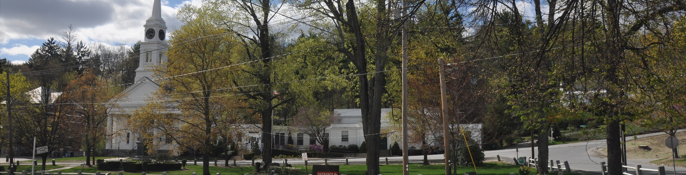
Sterling Common
This website and its contents were developed by Members of the First Congregation Unitarian Society of the First Church in Sterling.
Question and Answers Regarding Ownership of the Common
Further questions forthcoming (Updated May 6, 2011)


Who owns the Common?
The First Congregation Unitarian Society owns the Common and holds the 1742 deed from Elias Sawyer. It has held this deed for 279 years. The First Congregation Unitarian Society is one of four societies that today make up the federated First Church in Sterling. This makes it part of the property of the First Church. The other Societies are the Sterling Baptist Society, the First Evangelical Congregational Society, and the Sterling Interdenominational Society.
When was Church ownership of the Common first challenged?
Not until 2010! For 278 years, beginning in 1742 to the present the Church has exercised control over all its land without question.
From 1781 to 1835, the town funded and acted as a trustee of the church as was required by Article III of the Bill of Rights of the newly adopted 1780 Constitution of the Commonwealth of Massachusetts. In 1833, Article 11 of Amendment to the Massachusetts Constitution Article III of the Bill of Rights established separation of church and state. In 1836 the Sterling church withdrew from town support and incorporated as a legal entity separate from the Town of Sterling. The church again assumed full financial management of its affairs and its property, as had been the case between 1742 and 1781 as Precinct 2 of Lancaster.
Is the Common a separate parcel of property from that on which the church sits?
No. The Church owns its land as one parcel. The original deed from Elias Sawyer was for about three acres. Over the years, the church has given two of its three acres to The Town of Sterling for municipal purposes, for highway takings and to allow for the most recent expansion of the library.
Of the acre remaining, the church building occupies nearly all of the church land on the west side of Meetinghouse Hill Road and the Common land is directly across Meetinghouse Hill Road on the east side.
What is the definition a precinct? How was this word used in 1742 Lancaster?
From the Oxford English Dictionary, Third Edition 2007 online version 2011, the first definition (the most common usage over time since 1425) from the seven pages of entry for the word precinct which comes from the Latin word praecinctus to surround.
1.a. “The area within the boundaries (real or imaginary) of a particular place or building; the interior; the grounds; esp. the (consecrated) ground immediately surrounding a religious house or place of worship.”
2. a. An administrative district; …(N Amer.) a subdivision of a county, city or ward, etc. for election purposes; (also) a subdivision of a city or town for the purposes of police organization.
In Lancaster of 1742, an era when church attendance was mandatory, the Second Precinct/Second Parish was clearly established to provide a closer more convenient place in the town for residents of the Chocksett area to worship. The Second Precinct did not host municipal functions. There was only one place in Lancaster to vote on town matters and that was in Lancaster. Precinct meant parish/church by way of the actual usage of the space.